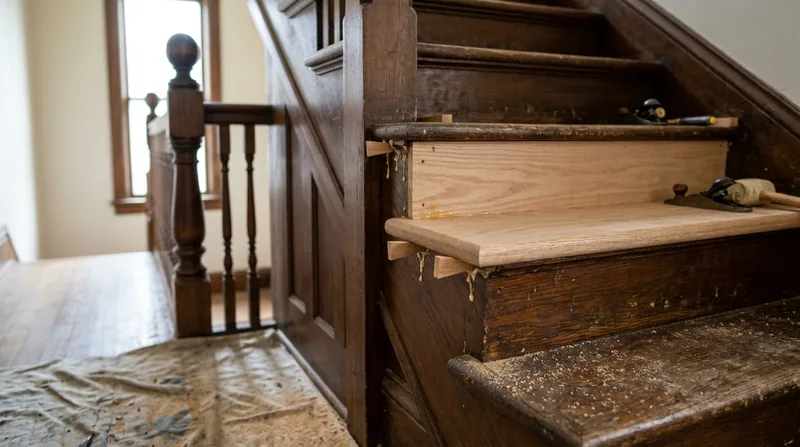




Sioux Falls homes climb stairs every day, and those stairs need to be safe, sound, and stable. From the grand main staircases in Victorian and Craftsman homes around the Cathedral district and McKennan Park to the steep basement flights in ranches and split-levels across south and east Sioux Falls, stairs and railings take constant use and weather exposure. Long winters, freeze-thaw cycles, humidity from damp basements, and wood-boring insects all weaken treads, stringers, and balusters over time. Stair and railing repair in Sioux Falls restores function, safety, and the character of period homes without unnecessary replacement. We rebuild squeaky treads, reinforce loose railings, repair rotted stringers, and install sturdy handrails and attic ladders, using sound wood and traditional joinery wherever the structure justifies it.
Why Stair and Railing Repair Matters in Sioux Falls Homes
Stairs in Sioux Falls take a specific kind of beating. Basement stairs in homes built over crawlspaces or sump pits sit in humid air year-round, softening stringers and risers from below. North-facing entry stairs and covered porches experience repeated freeze-thaw stress, which splits treads and loosens fasteners. Deep winter snow loads and spring meltwater can push moisture into stair framing under eaves. Victorian and Craftsman homes often have original newel posts and balusters that are loose or cracked but still structurally sound and historically valuable, worth restoring rather than replacing. Safety is the first reason to act, but preserving the original character of a home is often equally important to Sioux Falls homeowners.
- Squeaky treads signal loose fasteners or movement in the stringer, which worsens with each step and eventually creates a safety hazard.
- Loose railings and balusters fail to support a person's weight in a fall, and code requires them to resist 200 pounds of force applied horizontally.
- Rotted stringers, sills, or rim joists in basement stairs allow the entire flight to sag or shift, creating uneven treads and a tripping risk.
- Loose newel posts and period railings in historic homes can be tightened and reinforced without replacement, preserving original millwork and character.
- Attic ladders and pull-down stairs benefit from reinforcement and new hinges to ensure smooth, safe operation.
Addressing these issues promptly prevents falls, protects your home's structure, and maintains the integrity of period details that define Sioux Falls' residential character.
Local example: A 1920s Craftsman bungalow in Pettigrew Heights with original oak treads and turned balusters can often have its stringer sistered, treads screwed and glued, and balusters re-wedged and pinned for a fraction of the cost of rebuilding the entire staircase. We preserve the period character while restoring safety and function.
For guidance on stair code compliance and when a permit is required, the City of Sioux Falls Building Department can clarify local requirements for stair alterations and railing modifications.
How We Repair and Restore Stairs and Railings in Sioux Falls
Our process begins with a careful inspection of the entire staircase: treads, risers, stringers, railings, balusters, newel posts, and fasteners. We identify which components are structurally sound but loose or squeaky, which have rot or insect damage that requires replacement, and which are original and worth preserving. We then propose repair or rebuilding in order of cost-effectiveness and safety. Most stairs can be stabilized and made safe without a complete rebuild, using sistering, scribing, new fasteners, and selective board replacement where rot is localized.
- We inspect the full staircase, documenting movement, squeaks, rot, loose fasteners, and the condition of newel posts and balusters.
- We remove treads and risers as needed to access and assess stringers, checking for dry rot, carpenter ant damage, and structural integrity.
- We sister damaged stringers with new framing lumber, securing with construction adhesive and fasteners rated for the load.
- We replace rotted treads and risers with new lumber that matches the original species and profile, or reinforce original treads with screws and glue.
- We tighten balusters and newel posts using shims, glue, and fasteners, preserving original turning and period details wherever possible.
- We install or repair handrails, ensuring they meet code for height, diameter, and resistance to lateral force.
- We test the completed staircase for squeak, movement, and safety before we leave the job.
The goal is a staircase that climbs safely, quietly, and with the original character intact. For more information on related structural repairs, see our page on floor joist and subfloor repair, which often overlaps with basement stair work.
Sioux Falls example: A split-level home in south Sioux Falls had a basement staircase with rot in both stringers and loose balusters. We sistered the stringers with pressure-treated lumber, replaced three rotted treads, re-wedged and pinned the balusters, and installed a new graspable handrail. The job took three days and cost less than half the price of a new staircase, and the homeowner kept the original newel post and Victorian-era banister details.
| Approach | Description | Best for |
|---|---|---|
| Tightening and shimming | Removing play in balusters, newel posts, and treads using shims, adhesive, and new fasteners without replacing wood. | Squeaky stairs, loose balusters, original millwork worth preserving. |
| Sistering stringers | Bolting new framing lumber alongside a damaged stringer to restore load-bearing capacity without removing the staircase. | Rot, insect damage, or sagging in stringers where the original is too weak to stand alone. |
| Selective board replacement | Removing and replacing rotted treads, risers, or handrails with new lumber matching the original profile and species. | Localized rot in treads or risers, damaged handrails, or split risers that weaken the assembly. |
| Full staircase rebuild | Removing the entire staircase and building new stringers, treads, risers, and railings from scratch, reusing newel posts and balusters if sound. | Extensive rot in multiple components, unsafe geometry, or when repair cost approaches replacement cost. |
| Handrail and railing installation | Installing or upgrading handrails, balusters, and newel posts to meet current code and provide safe support. | Stairs without handrails, balusters that do not meet code spacing, or adding accessibility to existing stairs. |
Stair and Railing Repair Cost in Sioux Falls: What to Expect
The cost of stair and railing repair in Sioux Falls depends on the scope of damage, the extent of rot or insect damage, whether the original materials are being preserved, and how accessible the staircase is. A simple tightening and shimming job on a single-flight staircase with loose balusters and squeaky treads typically starts at $600 to $1,200. A basement staircase with rotted stringers requiring sistering and selective tread replacement usually runs $1,500 to $3,000. A full staircase rebuild with new stringers, treads, risers, and railings can range from $3,500 to $7,000 or more, depending on the number of flights, the complexity of the railings, and whether period details are being replicated.
Factors that move the cost up include the depth of rot in stringers, the number of balusters that need replacement, the species and thickness of original treads, the accessibility of the staircase (basement stairs in tight spaces cost more to work on), and whether a structural engineer is required to certify sistering or load-bearing modifications. If your staircase is part of a larger project, such as wood rot repair in the rim joist or basement sill plate, costs may increase. Travel is included in our pricing for Sioux Falls and surrounding areas, with no separate mileage charge.
We recommend getting 2 to 3 estimates to understand the range of proposed repairs and to verify that the work is necessary and appropriate for your home's condition. For a detailed pricing overview and examples, visit our full pricing page.
Stair and Railing Repair Near Me: What Sioux Falls Homeowners Should Know When Hiring a Contractor
Hiring a carpenter for stair and railing work requires checking a few key things: that the contractor is fully insured and can document coverage, that they can provide references from recent stair or railing jobs in Sioux Falls or nearby towns like Brandon, Tea, or Harrisburg, and that they understand local building codes and when a permit is required. Some cities and HOAs in the Sioux Falls area have rules about stair alterations, especially in historic districts or protected neighborhoods. It is worth asking your contractor whether a permit is needed before work begins, and asking them to clarify that requirement with your local building department.
- Verify that the contractor is fully insured with current liability and workers compensation coverage, and ask to see the certificate.
- Ask for references from at least two stair or railing jobs completed in the past two years, and call those homeowners to ask about quality, timeliness, and cleanup.
- Confirm whether a permit is required for your staircase work by asking your contractor to check with the local building department, or by calling the department yourself.
- If your home is in a historic district or HOA community, check whether there are restrictions on stair or railing modifications, especially if the work is visible from the street or affects exterior railings.
- Get a written estimate that breaks down labor, materials, and timeline, and that clearly states what is and is not included in the work.
A good contractor will explain what they find during the inspection, propose repair before replacement, and give you realistic timelines and costs. Ready to get started? Contact us for a free estimate or call (605) 800-6259.
Stair & Railing Repair in Sioux Falls: Pricing Guide
| Service | Price | Details |
|---|---|---|
| Tightening, shimming, and minor repairs | Starting at $600 | Squeaky treads, loose balusters, and tightening newel posts without structural replacement or extensive rot removal |
| Sistering stringers and selective board replacement | Starting at $1,500 | Reinforcing damaged stringers and replacing one to three rotted treads or risers while preserving the original staircase frame |
| Full staircase rebuild with new stringers and railings | Starting at $3,500 | Building new stringers, treads, risers, and railings, including reuse of original newel posts and balusters if structurally sound |
| Handrail and railing installation or upgrade | Starting at $800 | Installing new handrails, balusters, or newel posts to meet code and provide safe support for existing staircases |
| Travel and estimate | Included in Sioux Falls area | No separate call-out or mileage fee. Free estimate with response within 24 hours, no obligation to book |
Indicative pricing, the exact cost depends on square footage, finish, and site access. Free personalized estimate within 24h at (605) 800-6259.


